01 · OPERATIONAL CONTROL
The operating decisions are visible
VNISH brings performance, power, temperature, cooling and board state into one practical control surface. Each value supports a decision, a limit or a diagnostic step.
Find my S21 build
Tune and observe performance, power, temperatures and stability from a practical control surface.
VNISH brings performance, power, temperature, cooling and board state into one practical control surface. Each value supports a decision, a limit or a diagnostic step.
Find my S21 build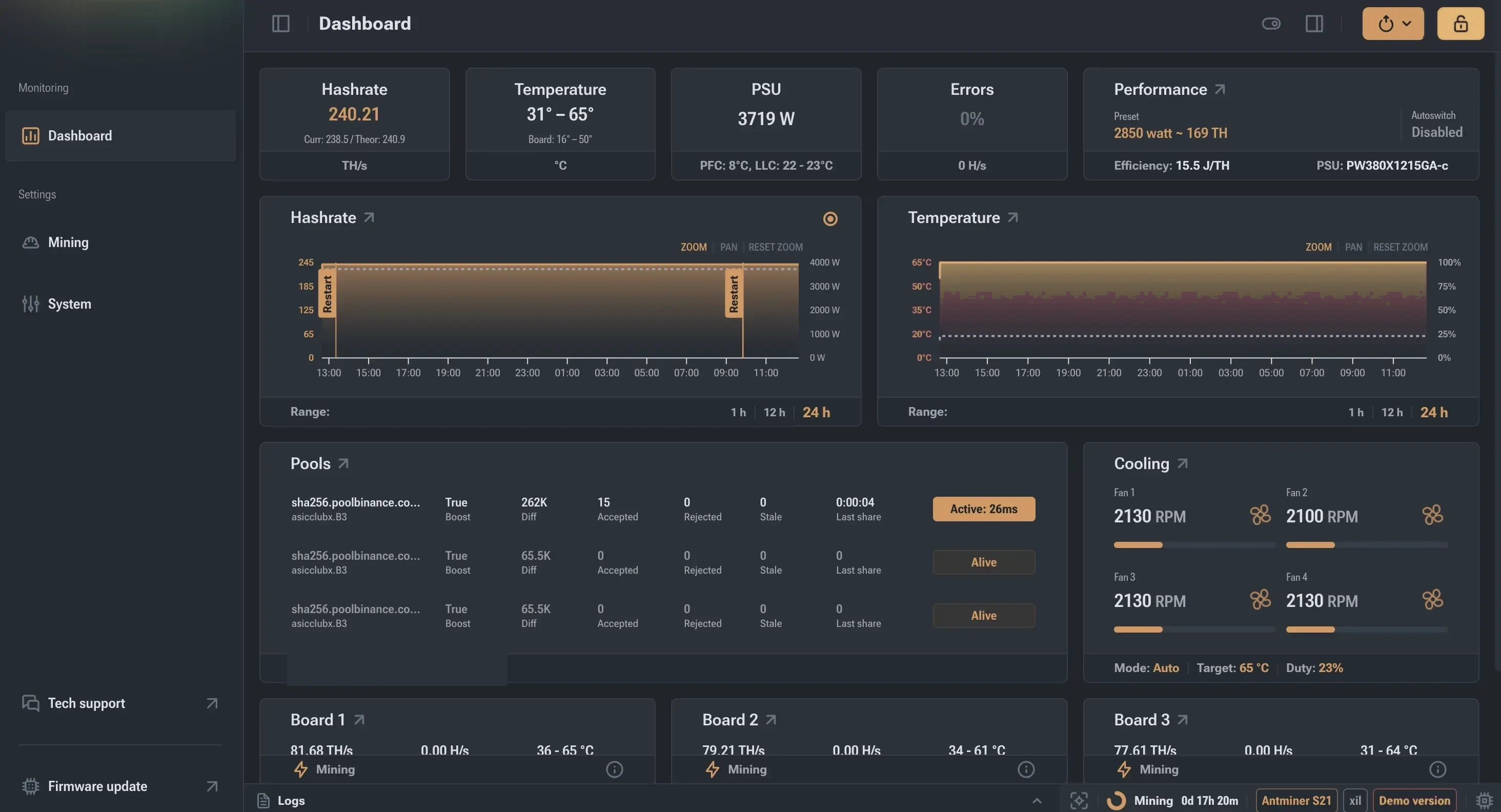
Official VNISH demo interface · Antminer S21 · Xilinx · example data · no performance promise
Signal → check fan and inlet context → reduce the target or stop when the defined limit is crossed.
Compare measured W/TH with the baseline before accepting a new operating point.
Preserve the error context, isolate the affected hashboard and revert a change rather than masking instability.
Firmware settings do not remove physical limits. They make the operating point visible and adjustable within the capabilities of the silicon, PSU, power input and cooling system.
Performance · Raise the target only while power, temperature and stability remain inside defined limits.
Efficiency · Find a lower W/TH operating point without assuming the same result across every unit.
Thermal and acoustic control · Coordinate temperature targets and fan behaviour for the actual site.
Stability under constraints · Use measured profiles when power, cooling, density or component condition is limiting.
Baseline → tune → observe → accept or revert. The accompanying scene is a concept illustration; control names are published only after verification for the exact build.
Control-board identity and hashboard/chip health are separate contexts. Confirm the current S21 glossary, error interpretation and export availability for the exact build with support.
Record build, settings, TH/s, measured power, W/TH, inlet/board/chip temperatures, fan state, errors and site conditions. No universal safe number is implied.